Blog

How do therapeutic peptide cell therapy drugs work?

In summary

Peptide therapeutics are small chains of amino acids (basically mini proteins) that can be used to treat diseases. They’re made of the same monomer (amino acid) as proteins, but proteins are much larger polymers than peptide drugs. The body naturally creates peptides for a bunch of different functions, so its a versatile way to create drugs whose presence creates signals for cell processes.

In depth

Hello and welcome back! After a very busy month and a half, let’s talk about peptide therapeutics.

In Boston, I see a ton of peptide therapeutic start ups popping up, but the actual peptide modality has been around for quite a while. Insulin is probably one of the most recognizable therapeutic peptides available on the market, but other commercially available, therapeutic peptides are used to treat bowel diseases, hereditary angioedema, and even HIV treatment. In terms of therapeutic modality sizing, peptides are the intermediate between small molecules (oligonucleotides) and large molecules (proteins). They’re made of the same monomer (amino acid) as proteins, but they’re a different class of medicine, because proteins are much larger polymers (thousands of amino acids) than peptide drugs (usually less than 100 amino acids). Check out the diagram below from a peptide manufacturer:

To understand how therapeutic peptides work, we need to go into a little bit about cell signaling. I like to think about cells like little radio towers, constantly transmitting and accepting signals to others towers. In one of the best understood cases, cells send chemical messages called ligands to other cells, and the cell that receives this message uses one of its hundreds of specialized receptors. Each cell type (such as pancreatic cells, neurons, and liver cells) has different kinds of receptors, because each message is designed to insight a different cellular response! So, in many cases, therapeutic peptides can act as these ligands that cue a certain cell type to perform a specific function.

Now, therapeutic peptides don’t exactly classify as gene therapy, and let me explain why. When we talked about ASOs and siRNA, we had modalities that were directly involved in gene regulation by say repressing translation. However, these therapeutic peptides aren’t exactly working within the central dogma–they don’t directly interfere with the DNA or RNA processes we think of with traditional gene therapy. I like to think of therapeutic peptides working more in parallel to gene therapy, because it’s helping the cell to insight a favorable response by exposing the cell to these artificial signals. For example, a study in the Journal of Medical Endocrinology found that the adrenocorticotropic hormone therapeutic peptide has been shown to regulate gene expression in adrenal cells. It’s not quite working on the DNA and RNA aspect of gene regulation, but it’s working in parallel on the cell side.
In literature

How do small interfering/short interfering/silencing RNA (siRNA) gene therapy drugs work?

In summary

siRNA drugs work very similarly to ASOs, because siRNA drugs ultimately prevent the “bad gene” from being translated. The siRNA drug mechanism is more complex though, because it starts as a double stranded RNA (dsRNA) molecule that undergoes several processing events by endo-ribonucleases to not only shorten the siRNA sequence but also to create a single stranded RNA (ssRNA) molecule from the original dsRNA molecule.

In depth

Last month, I went over how gene silencing drugs work using ASOs as an example, so feel free to reference that if you’re a little confused! Now, RNA interference (RNAi) technology is a pretty hot topic in gene therapy lately, and there’re a few different flavors–our friend, siRNA, is a more prominent modality, but we also have micro RNA (miRNA) and small-hairpin RNA (shRNA) that ultimately interfere with the RNA translation process in the body. And I’ll stick with siRNA today, but perhaps I’ll write a post in the future talking about the differences between these three if anyone is interested.

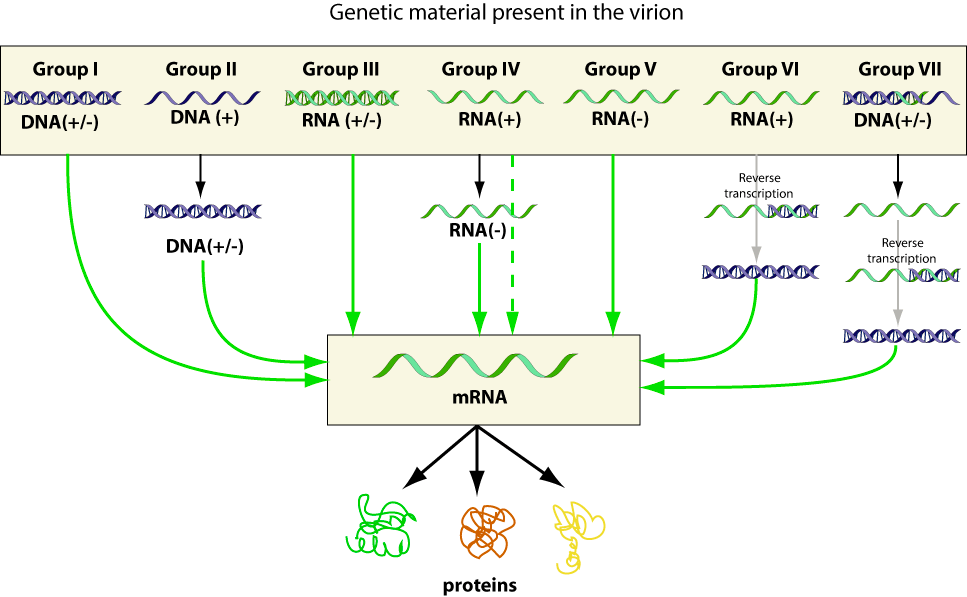
Now, let’s start with the dsRNA structure, because this is very unique. To do this, let’s go into some basic virology. dsRNA is not a common structure for human genetic information–DNA is double stranded, and RNA is single stranded, but dsRNA is abnormal. Now, when the body sees a foreign dsRNA molecule, it triggers an innate immune response, because it sees the dsRNA structure and thinks “virus!” Look at the picture below, and you can see that there’s a whole group of viruses (Group 3) that passes genetic information along in dsRNA form:

The Baltimore Classification from the Swiss Institute of Bioinformatics

Now, a good question is why are these drugs double stranded if that’s going to cause an innate immune response? One reason could be that dsRNA is much more stable than ssRNA. Another reason could be because DICER, our first protein type of the day, needs a dsRNA molecule to start the first series of siRNA processing events. One of the differences that I’ve noticed is that siRNA drugs differ from ASOs because siRNA drugs almost seem like prodrugs–they need a little more processing by these enzymes in the body to become functional, where as ASOs are pretty much ready to work as soon as they find their target site. And I’m sure there’re pros and cons to each, but let’s move onto the next stage.

Thanks to our friend, DICER, that cleaved the irrelevant pieces of our siRNA drug, we now have a shortened, but still dsRNA molecule. Since the siRNA molecule has been shortened to around ASO length (~20 base pairs), the siRNA molecule interacts with our second protein type of the day, the Argonaute proteins. The Argonaute proteins have a cool name because one of the proteins looks like an octopus, Argonauta argo! Once the dsRNA molecule forms an RNA-Induced Silencing Complex (RISC) with the Argonaute proteins, the siRNA is converted to a ssRNA molecule via an unwinding procedure. Now that there’re 2 strands of ssRNA, each is given a name. The unused strand of ssRNA is called the passenger strand, and it’ll be immediately degraded by the RISC. The ssRNA strand that does all the work is called the guide strand, and that strand will attach to the mRNA strand of the “bad gene.” Once the guide RNA strand binds to the mRNA strand, the RISC recognizes the siRNA-mRNA complex and cleaves the mRNA, rendering it untranslatable. The mRNA is then further degraded by cellular enzymes, as if it never existed.

Just like in ASOs, siRNA doesn’t solve the root problem of why the gene is failing, so it must be continually administered for therapeutic effect. However, I actually found this one paper that explains how siRNAs are more efficacious at gene expression inhibition than ASOs. Like this other paper explains, siRNA is technically less complicated in the body as well, because the mechanism is more like fitting puzzle pieces together than having to fit a million keys into a specific lock, which could add to the efficaciousness of RNAi as opposed to protein gene therapy modalities.

In literature

These are some of my favorite papers to help you learn more about siRNAs!

https://pubmed.ncbi.nlm.nih.gov/34044011/

https://pubmed.ncbi.nlm.nih.gov/22737048/

https://pubmed.ncbi.nlm.nih.gov/33513339/

Next month, let’s talk about a different type of modality, peptide gene therapy.

How do antisense oligonucleotide (ASO) gene therapy drugs work?

In summary

ASOs are short fragments of RNA that bind to nascent mRNA strands so ribosomes can’t bind to the nascent mRNA strand and create proteins. The key to this therapy is to remember that ribosomes need a single stranded mRNA molecule, and ASO therapies bind to the mRNA molecule, making it double stranded in some places. ASO therapies are gene therapy because they target defective genes to prevent the “bad” protein from being generated.

In depth

ASO therapies are an up-and-coming type of drug class that uses fragments of RNA to prevent defective proteins from being formed. Since mRNA is the template that ribosomes use to create proteins, a defective copy of mRNA can generate defective protein.

Nascent mRNA strands exist freely in the cytoplasm while they wait for a ribosome to bind to them and generate the protein—the perfect time for the nascent mRNA to become “deactivated.” An ASO has the reverse complement sequence to the target mRNA, so ASO molecule deactivates a nascent mRNA strand by base pairing to that target sequence. Since the ribosome can only bind to single stranded mRNA, and the ASO is binding where the ribosome wants to bind, the ribosome won’t interact with the mRNA to create the specific protein for which that mRNA molecule encodes.

Among gene therapy modalities, ASOs are advantageous because the concept is relatively simple. Once the ASO sequence is finalized, the molecule can be generated like any other oligonucleotide sequence with a bunch of organic chemistry reactions. Unlike a more technically complicated modality like CRISPR-Cas9, where we’re asking the drug to perform numerous steps, we’re just asking an ASO to stick to the mRNA strand like Velcro so the ribosomes bounce off. Additionally, unlike CRISPR-Cas9, the drug formulation doesn’t include a bunch of different drug components that need to magically come together and work in a cell. In traditional ASO therapies, no matter what kind of delivery mechanism you’re using, those short fragments are the only therapeutically active ingredient.

Given these benefits though, an ASO is a band aid, because it doesn’t actually solve the root cause of the genetic defect. Unlike CRISPR-Cas9, ASOs won’t fix the DNA that encodes for these defective mRNA strands. The cell will create these defective mRNA molecules into perpetuity and will need to be treated by long term ASO therapy. With ASOs, you’re not actually editing the genome—you’re negating the products of the defective genome. For nonessential proteins, the absence of having the protein at all probably beats having a defective copy. However, if the protein is essential, using a drug that completely inhibits its production is probably a bad idea.

In literature

These are some of my favorite papers to help you learn more about ASOs!

https://pubmed.ncbi.nlm.nih.gov/32964539/

https://pubmed.ncbi.nlm.nih.gov/30691367/

https://pubmed.ncbi.nlm.nih.gov/33762737/

Next month, let’s talk about a similarly functioning modality, siRNA.